
KLOW Peptide Side Effects: Risks & Human Evidence
KLOW peptide side effects explained: reported symptoms, FDA safety concerns, limited human evidence, serious warning signs and what remains unknown.

KLOW peptide side effects do not have reliable blend-specific rates in the human evidence reviewed here. Reports of reactions and FDA concerns about individual ingredients deserve attention, but neither establishes how often the four-peptide blend causes a symptom.
Key takeaways
- Blend evidence: We did not identify a controlled human safety trial of the four-ingredient KLOW blend in the sources reviewed.
- Reported symptoms: Online experiences are unverified accounts, not a list of proven or “common” KLOW reactions.
- Ingredient findings: Limited human BPC-157 evidence and full-length thymosin beta-4 trials cannot establish KLOW blend safety.
- Product testing: A certificate of analysis is not evidence that a blend is safe to inject.
- Warning signs: Breathing difficulty, face or tongue swelling, or collapse need emergency attention, whatever the cause.
Research context: This article evaluates safety evidence, not treatment or dosing. Research-use products are not intended for human consumption. PeptideStack is an independent informational and affiliate publisher, not a seller or healthcare provider.
Which symptoms need urgent medical attention?
Trouble breathing or swallowing, swelling of the face or tongue, and collapse can signal a medical emergency. Call 911 in the United States, or your local emergency number, rather than waiting for an online explanation.
These are general warning signs described by MedlinePlus on anaphylaxis, not reactions with measured KLOW-specific rates.
- Urgent assessment: Painful, hot, swollen skin—especially when redness is spreading—needs prompt medical evaluation. Do not assume it is routine injection irritation.
- Emergency assessment: Suspected skin infection with confusion, faintness, rapid breathing or marked systemic illness can indicate a serious complication.
The NHS cellulitis guidance supports these infection warnings. A symptom's timing alone cannot distinguish an allergic reaction, infection, irritation or an unrelated illness.
What side effects are reported or discussed with KLOW?
Headache, flushing, skin reactions and other symptoms appear in online discussions, but reliable KLOW-specific frequencies are unavailable. The evidence status matters more than calling a reaction “mild,” “rare” or “normal.”
| Symptom or question | Evidence status | What can reasonably be concluded? |
|---|---|---|
| Warmth, head pressure, brain fog or headache | One commenter explicitly described these after KLOW in a GHK-Cu discussion. | A self-report raises a question; it does not verify product contents, cause or frequency. |
| Sleep changes | A commenter in a KLOW/retatrutide thread reported less sleep while also taking other compounds. | The account cannot isolate KLOW or any one ingredient. |
| Redness, itching, soreness or swelling after injection | General injection-reaction concerns; no controlled KLOW rate identified. | A skin reaction should not automatically be attributed to GHK-Cu or dismissed as expected. |
| Nausea, dizziness or fatigue | Symptoms discussed in KLOW search results; no dependable blend-specific incidence identified in the reviewed clinical evidence. | Search visibility is not clinical confirmation, and symptoms can have other causes. |
The specific accounts above come from r/Biohackers' GHK-Cu discussion and r/Retatrutide's “Reta and KLOW users” thread, read October 27, 2026. Other commenters reported no side effects; neither positive nor negative anecdotes establish safety.
What is KLOW, and why does the label matter?
KLOW usually names a blend of GHK-Cu, BPC-157, TB-500 and KPV, rather than one standardized drug molecule. The actual ingredient identities and amounts must be checked against the specific product label.
Our separate KLOW peptide dosage guide covers labeled composition and concentration calculations. Those calculations do not establish a safe human dose; this article does not repeat administration instructions.
“TB-500” is a particularly important identity check. FDA's 2026 evaluation addresses a seven-amino-acid thymosin beta-4 fragment, not every product marketed under that name.
What does human evidence say about the four ingredients?
The ingredients have different evidence gaps, and none of the findings below validates the combined KLOW product. Regulatory concerns, observed study outcomes and missing information are separate categories.
| Ingredient | Evidence reviewed | Important limit for KLOW |
|---|---|---|
| BPC-157 | A 2025 intravenous pilot reported no side effects in two adults during a short observation period. FDA also reviewed other limited human reports. | Two previously exposed participants and a different route cannot establish blend safety or rule out uncommon or delayed harms. |
| GHK-Cu | FDA identifies limited human safety data for injectable preparations and potential immunogenicity from aggregation and peptide-related impurities. | Findings about skin-applied products cannot establish safety when a copper peptide is injected as part of a blend. |
| KPV | FDA's 2026 evaluation did not identify information on KPV products administered in humans. | Absence of usable human evidence is not evidence that KPV has no side effects. |
| TB-500 fragment | FDA reports no identified human exposure data for the specified thymosin beta-4 fragment. | Clinical studies of full-length thymosin beta-4 are not interchangeable with fragment or KLOW studies. |
Sources: FDA ingredient safety concerns, BPC-157 human pilot, and FDA's 2026 evaluations of BPC-157, KPV and TB-500.
Why doesn't the BPC-157 pilot prove safety?
The pilot's reassuring observations are too limited to establish broad safety. The two participants had received intravenous BPC-157 before, and assessments covered three days.
The authors reported no side effects or measurable changes in selected tested biomarkers. That is a finding about those participants and that preparation, not a controlled test of KLOW, long-term exposure or every possible adverse effect.
Are thymosin beta-4 trials evidence for TB-500?
Not automatically: the exact molecule and formulation must match. A 2010 randomized intravenous thymosin beta-4 study enrolled four cohorts of ten healthy volunteers and reported no serious adverse events or dose-limiting toxicity.
That trial evaluated synthetic thymosin beta-4, not the seven-amino-acid fragment evaluated in FDA's TB-500 briefing, and not KLOW. Borrowing its tolerability results for a differently identified blend would overstate the evidence.
Why can't topical GHK-Cu findings establish injection safety?
Applying a product to skin and injecting a preparation are different exposures. Product formulation, impurities and the route into the body matter; a topical product's tolerability does not validate an injected blend.
FDA specifically identifies aggregation and peptide-related impurities as potential immunogenicity concerns for injectable GHK-Cu. Immunogenicity means the potential to provoke an immune response; it is not a measured KLOW allergy rate.
For the broader single-compound-versus-blend distinction, see GHK-Cu vs KLOW.
What does the FDA evidence mean in 2026?
FDA's ingredient assessments identify safety concerns and missing data, not approval of KLOW as a finished treatment. A compounding assessment, an advisory recommendation and marketing approval are different regulatory decisions.
On the FDA safety-risk page checked October 27, 2026, the relevant BPC-157, injectable GHK-Cu, KPV and TB-500-fragment entries appear under withdrawn nominations. Describing all four as currently Category 2 would miss that distinction.
- BPC-157: FDA discusses immunogenicity, peptide-related impurities and difficulty characterizing the active ingredient.
- KPV and TB-500: The July 2026 briefing evaluations weigh against inclusion on the 503A bulks list. Briefing documents are background for deliberation, not final determinations.
- GHK-Cu: The injectable-route warning must not be flattened into a claim about every topical cosmetic product.
The FDA meeting page explains that advisory recommendations are nonbinding. Our GHK-Cu FDA approval status guide provides separate ingredient context.
Does a certificate of analysis establish KLOW safety?
No. A certificate of analysis can describe the tested characteristics of a sample, but cannot establish clinical safety, interaction risk or long-term outcomes.
Identity, purity and quantity are different questions from sterility, bacterial endotoxins and the effects of repeated exposure. A high purity percentage is not a substitute for the tests that were not performed.
FDA's 2026 TB-500 briefing provides a concrete example: the certificate submitted for TB-500 acetate did not provide results for identification, assay, aggregates or bacterial endotoxin levels. That finding concerns the submitted document; it is not a claim that every KLOW supplier has the same omissions.
Can a reaction be attributed to KLOW or one ingredient?
Not from timing or a forum post alone. A blend exposes a person to several ingredients together, while other products, uncertain contents and unrelated illness can complicate attribution.
Community reports illustrate the problem:
- Concurrent products: The KLOW/retatrutide thread includes multiple compounds and conflicting experiences. It cannot establish that combining those products is safe.
- Misidentified blend: A r/PeptidePathways post titled “KLOW Blend Research Update” corrects the initial exposure to GLOW in its body. It should not be counted as a confirmed KLOW adverse event.
- Unverified mechanism: A commenter calling symptoms “copper toxicity” or a “histamine reaction” does not establish that diagnosis.
These are examples of reporting limitations, not a representative survey. A clinician evaluating a reaction needs the product label, exposure timing and other medicines or supplements—not an assumed explanation from the blend's name.
What remains unknown about long-term effects and interactions?
The reviewed evidence does not establish KLOW's long-term safety, reliable interaction rates or safety during pregnancy and breastfeeding. It also does not establish that adding KLOW to semaglutide, tirzepatide or retatrutide is safe.
FDA's KPV evaluation identified no nonclinical developmental or reproductive studies. An evidence gap for one component makes confident pregnancy-safety claims about the complete blend especially unsupported.
Do not interpret the absence of a documented interaction as proof of compatibility. Discuss symptoms and exposures with a qualified healthcare professional rather than changing prescribed treatment based on forum advice.
Frequently asked questions
How long do KLOW side effects last?
There is no validated KLOW-specific duration established by the reviewed evidence. One person's report that symptoms resolved within a day cannot predict another person's course or justify delaying assessment.
Does KLOW cause copper toxicity?
The reviewed evidence does not establish a KLOW-specific copper-toxicity rate. GHK-Cu contains copper, but headache, warmth or nausea alone cannot diagnose copper toxicity or identify the responsible ingredient.
Is KLOW safer than GLOW?
A controlled head-to-head safety comparison was not identified in the reviewed sources. Adding KPV changes the formulation; it does not establish that KLOW is safer, more dangerous or better tolerated than GLOW.
Is there a clinically established safe KLOW dose?
No clinically established safe dose for the four-ingredient blend was identified in the reviewed evidence. Concentration math, community schedules and individual-ingredient studies cannot supply that missing clinical validation.
Is KLOW FDA-approved?
No FDA-approved KLOW blend was identified in the regulatory sources reviewed. Ingredient discussion in a compounding briefing is not approval of a finished KLOW product.
Bottom line: evidence limits are part of the answer
KLOW side-effect claims need to be separated into reported symptoms, ingredient-level findings and unquantified risks. The sources reviewed do not support reliable blend-specific frequencies, a safe dosing schedule or reassurance that reactions are usually harmless.
This guide is for readers evaluating safety claims, not choosing or managing a peptide treatment. We could not verify controlled human KLOW safety trials, long-term blend outcomes or validated combination-use guidance.
Sources checked: October 27, 2026. The review used the linked FDA materials, published human-study abstracts, general clinical warning-sign guidance and the identified community threads. It is a focused evidence review, not a systematic review or a clinical diagnosis.
You Might Also Like
KLOW Peptide Dosage: Chart & Reconstitution Guide
KLOW peptide dosage chart: reconstitute the 80mg vial with 2mL BAC water, standard 5–10 unit research doses, and per-component breakdown.
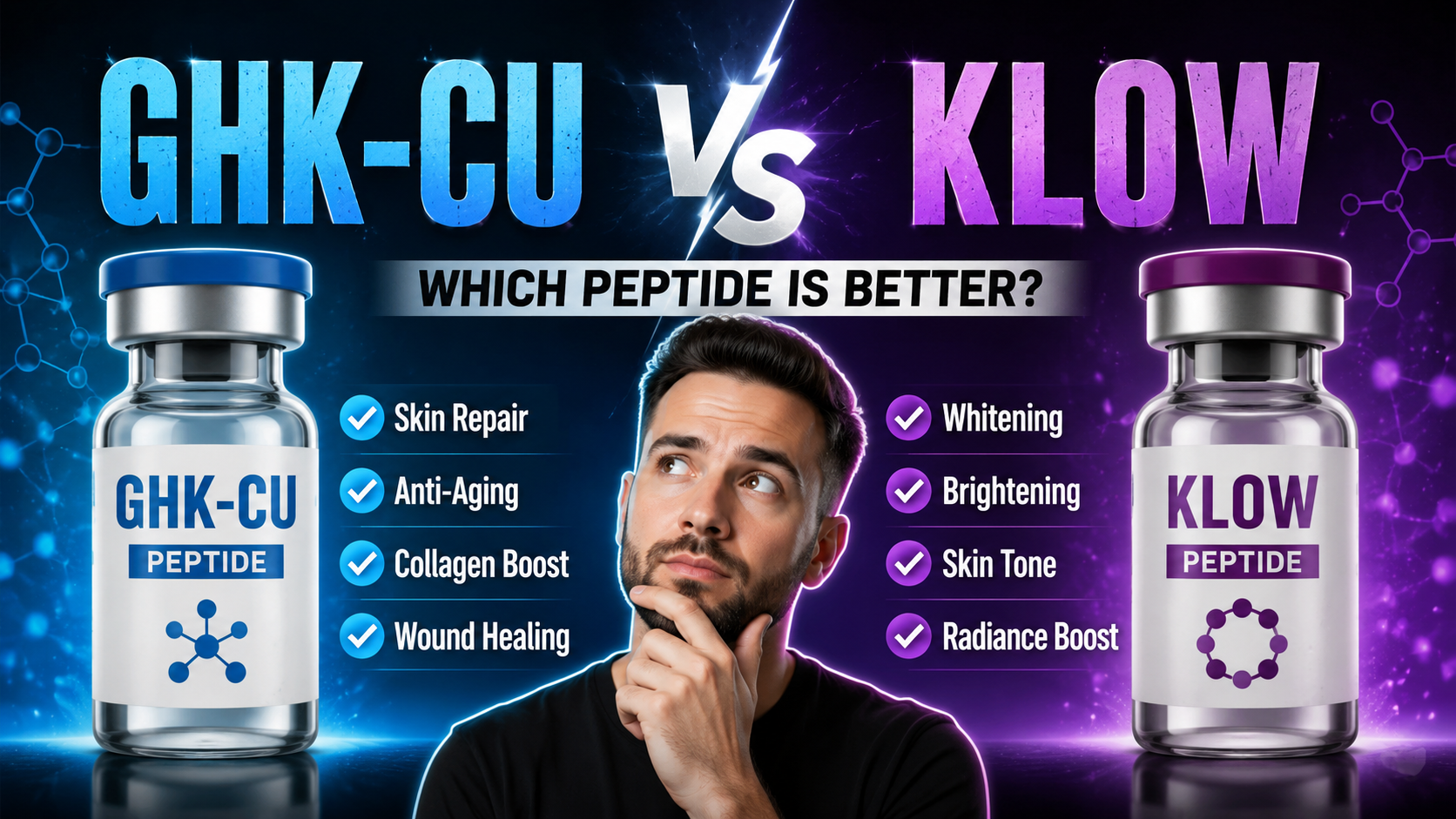
GHK-Cu vs KLOW: How Do They Compare?
GHK-Cu vs Klow Peptide comparison for skin-focused research: single copper peptide vs blend positioning, evidence, COAs, and use cases.

GHK-Cu FDA Approval Status 2026: Injectable Rules
Is GHK-Cu FDA approved? No. Full 2026 regulatory status, Category 2 reclassification updates, compounding regulations, and published research.